
Reshaped and repaved

The personal car completely reshaped how people thought about travel in the early 20th century. Suddenly, going a long distance didn’t require careful planning around a train schedule. Instead of choosing between a handful of departures a day, people could leave whenever they wanted. City planners and experts at the time tried to predict how car ownership would grow, but they badly underestimated just how fast Americans would embrace driving. The demand for roads shot up far beyond what anyone expected, and many highways and city streets were quickly overwhelmed. Even when it became clear that the predictions were wrong, planners and politicians didn’t stop to rethink their approach. Instead, they pushed even harder for expansion. Backed by strong political support and massive government funding, cities across the country doubled down on building more highways.
With new cars and new roads, Americans became more mobile than ever before. In many ways, that optimism wasn’t misplaced. Cars and highways connected towns and cities in ways that had never been possible. For countless communities, highways became economic lifelines. Many people truly benefited from the freedom and flexibility that cars provided. But the belief that every city and every community needed to be built around highways was driven more by hope and excitement than by careful long-term thinking.
Robert Moses, the powerful New York planner and Secretary of State of New York in the late 1920s, understood just how big the changes would be. He warned, “This new highway program will affect our entire economic and social structure. The appearance of the new arteries and their adjacent areas will leave a permanent imprint on our communities and people. They will constitute the framework within which we must live.”
Critics of Moses, however, believe he was the reason many New York communities were hurt by the car and highway revolution.
People often say that American cities were “built for the car,” but that’s not really true. Most major cities existed long before personal cars became common. In the late 1800s and early 1900s, streets were dense, lively, and walkable, filled with people, streetcars, and small businesses—much like European cities of the time.
When cars took off in the 1920s, and especially when highway construction exploded after World War II in the 1950s and 60s, cities began reshaping themselves to fit automobiles. Streets were widened, neighborhoods were demolished, and businesses were torn down to make room for expressways. Highways cut directly through established communities, and suburban growth after the war pulled people farther from city centers, lowering population density. As Moses predicted, these highways became the “framework within which we must live.” The traffic congestion that followed was almost inevitable, and trying to solve it by adding more lanes and building more roads often only deepened the problem rather than fixing it.
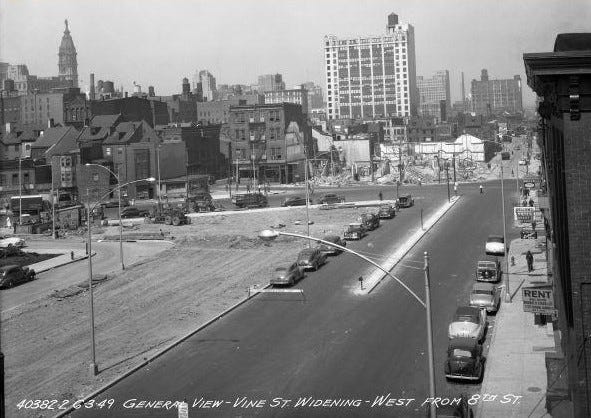
From Vintage Philadelphia on Facebook
The car-centered vision of progress reshaped American cities in lasting ways, often sacrificing established neighborhoods in the name of mobility and growth. In Philadelphia, the construction of Interstate 676 (the Vine Street Expressway), completed in 1991, carved through communities like Chinatown, and the congestion, division, and urban challenges that remain today reflect how those mid-century highway decisions continue to shape city life today.